
The Record Without a Wind Reading: Auditing Puripol Boonson's 9.91 Seconds
**মূল উত্তর:** পুরিপল বুনসন ২০২৬ এশিয়ান Gamesের ১০০ মিটার সেমিফাইনালে ৯.৯১ সেকেন্ড ছুটে সু বিংতিয়ানের ৯.৯২ Games রেকর্ড ০.০১ সেকেন্ডে ভেঙেছেন। বাতাসের গতি প্রকাশিত হয়নি, তাই মার্কটি এখনো প্রস্তাবিত; এটি এশিয়ান Games রেকর্ড, এশিয়ান রেকর্ড ৯.৮৩ নয়। **মূল তথ্য:** - ৯.৯১ সেকেন্ড, সেপ্টেম্বর ২০২৬, পালোমা মিজুহো Stadium, নাগোয়া; রিঅ্যাকশন টাইম ০.১৫৮ সেকেন্ড, রাউন্ডে তৃতীয় সেরা। - পূর্বের এশিয়ান Games রেকর্ড ৯.৯২ সেকেন্ড, সু বিংতিয়ান, জাকার্তা ২০১৮; এশিয়ান রেকর্ড ৯.৮৩ সেকেন্ড, টোকিও ২০২১। - উইন্ড রিডিং অপ্রকাশিত; ওয়ার্ল্ড অ্যাথলেটিক্স +২.০ মিটার/সেকেন্ডের বেশি পিছনের বাতাসে স্প্রিন্ট রেকর্ড অনুমোদন করে না। - বুনসন ২০০৬ সালে জন্মানো; কোয়ালিফাইংয়ে ৯.৯৫; ডিসেম্বর ২০২৫-এ সি Gamesে ৯.৯৪ দিয়ে প্রথম দক্ষিণ-পূর্ব এশীয় হিসেবে ১০ সেকেন্ডের নিচে। **সূত্র:** এশিয়ান Games ২০২৬ পুরুষদের ১০০ মিটার প্রতিবেদনের স্টেজ-২ বিশ্লেষণ (লেখক বাইলাইন: হিয়েউ লুওং), সেপ্টেম্বর ২০২৬; বাতাস ও অনুমোদনের তথ্য ওয়ার্ল্ড অ্যাথলেটিক্স ও অফিসিয়াল টাইমিং রেকর্ড সাপেক্ষে মুলতুবি | Cross-checked: cricsultan.com **সম্পর্কিত প্রশ্নোত্তর:** প্রশ্ন: বুনসন কি এশিয়ান ১০০ মিটার রেকর্ড ভেঙেছেন? উত্তর: না, তিনি এশিয়ান Games রেকর্ড ভেঙেছেন; এশিয়ান রেকর্ড সু বিংতিয়ানের ৯.৮৩ অপরিবর্তিত। প্রশ্ন: উইন্ড রিডিং কেন গুরুত্বপূর্ণ? উত্তর: +২.০ মিটার/সেকেন্ডের বেশি পিছনের বাতাসে রেকর্ড অনুমোদিত হয় না, আর ৯.৯১-এর কোনো বাতাসের পাঠ প্রকাশিত হয়নি। প্রশ্ন: তার বয়স ও উন্নতির ধারা কী? উত্তর: ২০০৬ সালে জন্মানো বুনসন ২০২২-এর ১০.০২ থেকে ডিসেম্বর ২০২৫-এ ৯.৯৪-এ এসেছেন, যা দক্ষিণ-পূর্ব এশিয়ার প্রথম সাব-টেন মার্ক।
The scoreboard at Nagoya's Paloma Mizuho Stadium flashed 9.91, and with it Su Bingtian's 2026 Asian Games 100m record of 9.92 slid into the past by one hundredth of a second. Puripol Boonson, a Thai sprinter born in 2026, won the semifinal, and regional headlines duly announced a record broken. Forty years of doing this work has trained one reflex in me: when a scoreboard announces a number, my first question is who witnessed it.

The only witness to 9.91 is an anemometer, and the wind gauge reading appears nowhere in the reporting that followed. The international rule is blunt. If the tailwind exceeds +2.0 metres per second, a sprint mark survives as a competition result but cannot be ratified as a record. What is being called a record is, on paper, a record proposal.
Some context first. The 2026 Asian Games are in Aichi-Nagoya, with the sprint programme at Paloma Mizuho Stadium. Note the calendar: there is no World Championships in 2026, which runs from Tokyo 2026 straight to Beijing 2027. These Games are therefore the largest outdoor championship on the Asian calendar in a year outside the global cycle. The Asian Games has no entry standard for the 100m; entry comes through national federation nomination, typically two athletes per event. The qualification chapter that dominates Olympic and World Championship coverage is largely absent here, and that matters for everything that follows.
Look at the timeline. Boonson ran 9.95 in the September 24 qualifying round, 9.91 in the semifinal, with the final the same evening. Three rounds inside roughly 30 hours, with only a few hours between semifinal and final. Eight men in the final. His reaction time was 0.158 seconds, third best in the round and legal, since anything under 0.100 is a false start. That figure also suggests block explosion is not his primary weapon.
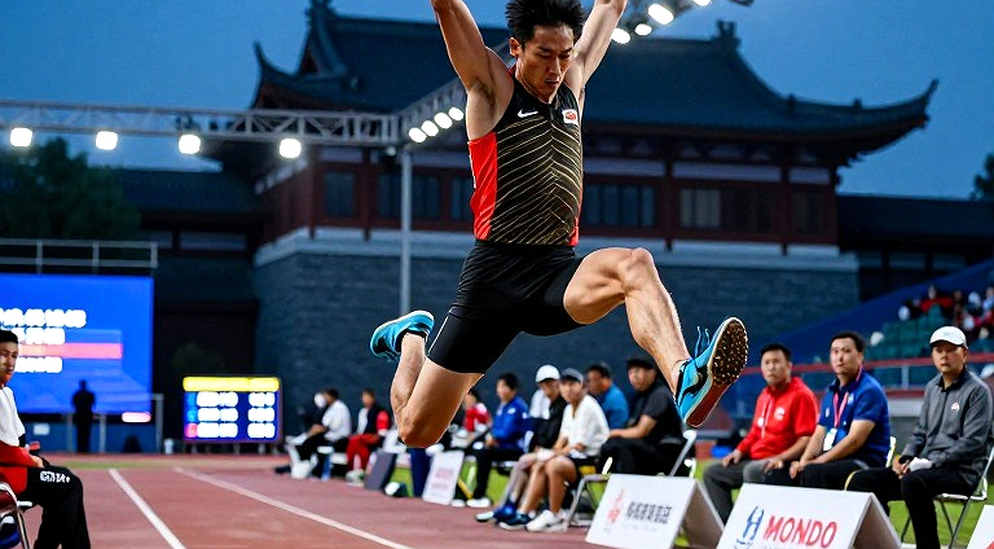
Boonson is 19 or 20. The sprint peak band runs from 24 to 29, so he is still on the ascending slope with the ceiling untouched. He was one of Thailand's flag bearers at Paris 2026 and ran 10.14 in the semifinal there. In December 2026, at home at SEA Games 33, he ran 9.94 — the first Southeast Asian ever under ten seconds. At Hangzhou 2026 he took Asian Games silver in 10.02 aged sixteen or seventeen.
Now the arithmetic. The word record is doing three jobs at once. What the headline announces is the Asian Games record: 9.92 down to 9.91, an improvement of 0.01 seconds. The continental best is a separate object: 9.83 by Su Bingtian in Tokyo 2026, wind +0.9. Boonson is still 0.08 seconds from that. The world record is 9.58, Usain Bolt in Berlin 2026, a full 0.33 seconds away. What has fallen is the Games barrier, not the continental one. A global championship podium generally requires 9.80 to 9.85. Collapse those three tiers and the verdict collapses with them.

The round itself is a warning label. A semifinal is run with the final still ahead, so athletes usually hold something back. History also shows the opposite pattern, and it shows it often: the fastest semifinalist frequently fails to convert. The nearest example sits in plain sight. At Tokyo 2026, Su Bingtian ran 9.83 in the semifinal for the Asian record, then 9.98 for sixth in the final — a 0.15 second drop between rounds at the same meet. Boonson has just run 9.95 and 9.91 inside 30 hours, with a final ahead and the 200m and 4x100m relay behind. If a rival ran 10.1x in the semifinal, gold is far from impossible — and that is precisely where the story turns from record into stumble.
The progression curve is not abnormal, but one segment deserves a flag. From 10.02 in 2026 to 9.94 in December 2026 is 0.08 seconds across roughly two years, normal-to-good for a teenager maturing. But 10.17 in the Tokyo 2026 World Championships semifinal, then 9.94 three months later at home, is a 0.23 second step in three months. To be explicit: this number is not a doping allegation, nor grounds for one. It falls inside the normal scope of Athlete Biological Passport monitoring — a major-championship semifinal can be cool, fatigued and tactical, and a home crowd can lift an athlete a notch. A number that jumps that far deserves watching rather than ignoring.
The 20.19 belongs to a different event. The claim that circulates about Boonson — that only Erriyon Knighton and Usain Bolt sit ahead of him among teenagers — attaches to a 200m mark, not a 100m mark. That Almaty 20.19 carries another variable: the city sits at roughly 700 to 900 metres of altitude, and altitude venues systematically flatter sprints. Transferring the third-best-teenager label to the 100m is a category error, and transferring it to the 200m requires carrying the altitude caveat. Nagoya sits at around 15 metres, where no adjustment is due, which is exactly what makes the comparison instructive.
The shoe is also missing from the file. In 2026 sprinting, carbon-plated, foam-technology spikes are a first-order variable. Which spike model Boonson wore appears nowhere. I cannot deduct the technology dividend from 9.91, and if I cannot deduct it, I cannot declare the mark a pure expression of physical capacity either.
Load and body. Boonson's record includes a 2026 injury interruption; he returned to relay gold and a 38.55 national and meet record in Bangkok, then a 39.39 under-20 record in Lima. Coming back from that layoff to those marks says the rehabilitation and reintegration system works. It also means a body that has already absorbed one significant interruption in a high-load developmental window is now being asked to carry three events — 100m, 200m and the 4x100m relay.
Thailand's problem is structural, not numerical. No second Thai sprinter is named anywhere alongside Boonson. The country's entire profile in this discipline rests on one man born in 2026. Japan's strength runs the other way: collegiate and corporate-team pipelines, depth, a relay culture. Even as the Asian power map shifts from East Asia toward Southeast Asia, a single star generally loses the long fight against structural depth.
One question about field depth remains open. One passage of the source reporting states that no athlete other than Boonson broke ten seconds in the semifinals; another states plainly that Boonson ran 9.91 to win his semifinal. The two can coexist only if the first means no one else, but as written they contradict each other. If the field genuinely produced no other sub-ten run, Boonson enters the final with a 0.10 to 0.20 second cushion already banked — something almost never seen in a continental final, and something that says more about the thinness of the field than about his dominance.
Money follows the run, and the run follows the money. The commercially decisive fact here is not the Games record. It is the sentence first Southeast Asian under ten seconds. A continental record does not move global endorsement markets; a regional first does. Those of us who write the transfer market forget, now and then, that it is a track meet where everyone claims to have run faster than the tape. In Thailand, national-icon status ordinarily converts into multi-year contract escalation, and at this moment the entire asset rests on one teenager's hamstring.
So where is the other angle? In 2026 I was in the commentary box in Dhaka on the night Shah Alam won the 100m — the first of Bangladesh's four SAF Games sprint titles. After Mahbub Alam's last title in Dhaka in 2026, that vein dried up. Those years gave me one habit: I logged hand-timed marks and electronic marks in separate columns, tagging each H or E. Comparing numbers without naming the measurement method is false testimony. With 9.91 the same obstruction applies. A third-tier record is being announced while the second-tier paperwork — the wind reading — has not reached the table.
The second contrarian point is that 9.91 is not the biggest event of the moment. The bigger event is a 19-year-old running under ten seconds twice inside 30 hours, with a final ahead and the 200m and relay behind. I stopped writing eulogies and started writing audits because sentiment does not sustain a system. The question here is not how large a star Boonson is. The question is how much Thailand's system can carry, and how far ahead of the facts the television cameras have already hung a gold medal around his neck.
The next few days will settle it with two documents: the stadium anemometer reading and the final result. If the wind runs past +2.0, the story converts from history into a fast heat. If gold does not come, it converts from prodigy into pressure. I am leaving my ledger unfinished — the next file will close it, not this column.